As
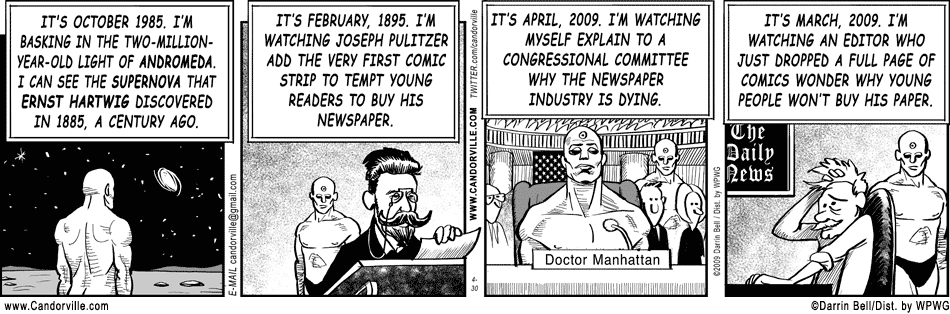
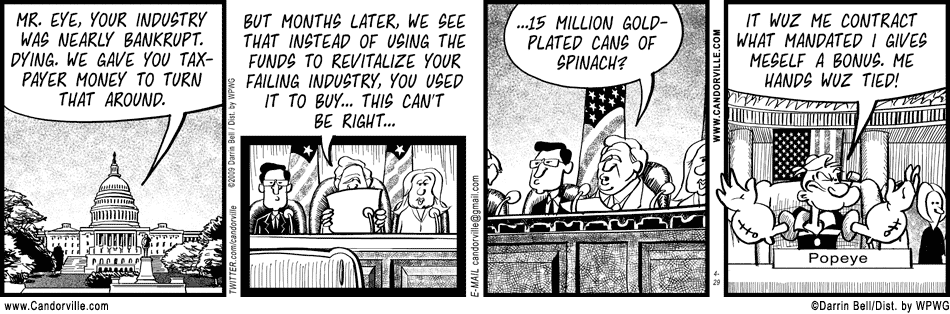
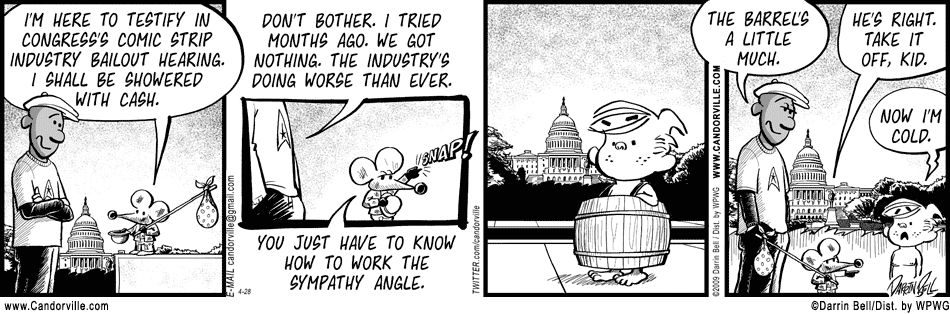
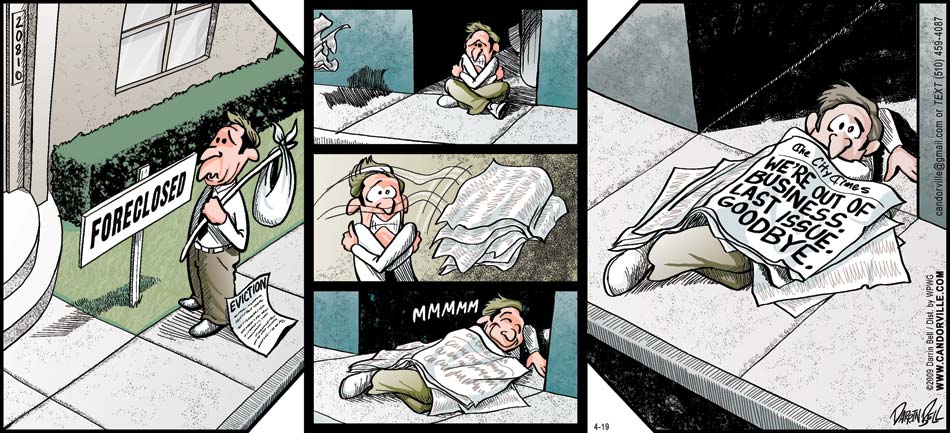
Saxon Kenchu would say, “the irony is ironic.” My comics appear in newspapers. My livelihood is largely dependent on newspapers. But I haven’t subscribed to a newspaper in almost ten years, and I only buy a copy of my local paper when I want to see how a new brush or a new shading technique I’m using looks in print. I’m part of the reason why newspapers are on their deathbed. For the last decade, almost, I’ve been getting my news online.
It’s just so much easier. I can tell Google what I’m interested in, and every time I visit I’ll see a list of new articles that satisfy my interests. I can subscribe to RSS feeds, or to Twitter streams from CNN, Buzzflash, Fox, or whatever, and every time I tap the “Twittelator Pro” icon on my iPhone, they update me with breaking news and opinion.
All these conveniences have one thing in common: They all generally rely on newspaper articles for their content.
Some have suggested that newspapers should start charging bloggers who quote their articles, and force sites like Google and Huffington Post to pay a price for their practices: Google because they make money selling ads on pages comprised of headlines grabbed from newspapers, and Huffington because its writers often grab large chunks of copyrighted articles, and the site earns ad revenue from that.
But that’s a half-assed measure. The online versions of papers have to do more than charge aggregators a fee or run Google ads if they’re going to become lucrative enough to support 200-person investigative newsrooms once print finally dies. They’ve got to charge their readers.
Why would readers pay? I’ve asked myself, what would get ME to pay for news again, if I’ve been basically freeloading for the last decade? The knowledge that I’m doing my part to preserve the Fourth Estate and thereby save our democracy might not be enough; not when I have to choose between that and being able to afford to upgrade my iPhone every year. The papers have to offer me something I can’t get from the aggregators: even more convenience, and even more personalization.
I would pay $10/month to latimes.com if they could give me the following:
1. Custom news and opinion, Google-style.
When I sign up, give me a page of topics that I can check off. “International news.” “Local news.” “News about (fill in the blank)”. Etc… My choices would be supplemented by a rotating list of random stories outside my chosen interests, so I won’t be just a provincial reader. Each article should be accompanied by a bio of the author and buttons for buying books by those authors. The paper would get a percentage of any sale made through those buttons, Amazon Associates-style.
2. Custom coupons.
Give me another page at sign-up where I can check off products I buy, and neighborhoods & stores in which I shop. Show me a running total as I check off the boxes of how much I’m likely to save on average each month by subscribing. If I’m
likely to save $20/month, buying a $10/month subscription would be a no-brainer right there.
3. Custom comics.
Let me choose from lists of comics: “Adult comics,” “family comics,” “political satire,” etc., and then let me delete comics I don’t like from those lists. Let readers rate the strips each day, and then offer readers a “Today’s top ten” list which would compile based on the rating regardless of whether the comic was rated by ten or ten thousand people. That way readers would find new, high-rated comics they’ve never heard of before. The comic would have a “block this comic” link so it wouldn’t be included in future top tens if you don’t want it to be. Each comic offered should have buttons for buying books & related merchandise, and papers would get a percentage of the sale for anything the reader buys through those buttons.
4. Local Craigslist-like services.
The difference would be you’d get another check-box page at sign-up where you can specify what you’re looking for: apartments, jobs, relationships, whatever, and you’re presented with a daily list of listings that meet your requirements, without you having to re-enter the information all the time.
5. Features, features, features
Crosswords, horoscopes, advice columns, etc. that, again, you can customize, and again, allowing you to buy books with a percentage going to the paper.
6. Local communities.
If you live in Glendale, you’re signed up to the Glendale latimes.com reader community, and you see a summary of activity (the last five or ten actions) in the community updating in real-time. Includes a community calendar, so if there’s a local art gallery showing, or high school baseball game, or a local independent filmmaker’s work debuts, you’re invited, with a map and a link to buy tickets if applicable (and, you guessed it, a portion of that sale would go to the newspaper).
7. Localized YouTube-like channels
…where local readers can share videos they create. Live in Oakland and want to see clips by fellow Oaklanders? The latest and most popular are listed right there.
And you get all of this sent to you in an HTML e-mail every morning that’s styled to look like the front page of the newspaper. You can read it on your computer, your iPhone, your Blackberry, or whatever, and it’s customized on the fly for each device.
The difference between this and sites like My Google or Yahoo are minimal. But they’d be much more noticeable
once an online paper like latimes.com refused to allow Google or Yahoo access to their local news, simply by putting the site behind a pay gate and by refusing to provide anything other than headlines to the wire services. You wouldn’t need some conspiracy or some cartel of papers deciding to do this en masse, each paper could decide for itself whether to do this. If, for instance, the LA Times chose to restrict its content this way, Los Angeles readers wanting local news would have to pay for it because the aggregators would no longer have a source for local Los Angeles news.
The convenience this service would offer, combining wire reports with exclusive local reporting, local communities and local coupons tailored to each reader, would be worth the money. In fact, the ability to personalize local services might lead to more than one subscription per household. Adults who enjoy their local news might want to set up local news, comics & services customized for their eight year-olds.
I would subscribe if I could find all that in my inbox AND on my iPhone every morning, and couldn’t get the same information for free elsewhere.