
SEE MORE
DARRIN BELL
PROJECTS
HERE

The Freeloader Myth

More BS from the credit card companies. From the NY Times:
Congress is moving to limit the penalties on riskier borrowers, who have become a prime source of billions of dollars in fee revenue for the industry. And to make up for lost income, the card companies are going after those people with sterling credit. Banks are expected to look at reviving annual fees, curtailing cash-back and other rewards programs and charging interest immediately on a purchase instead of allowing a grace period of weeks, according to bank officials and trade groups. “It will be a different business,” said Edward L. Yingling, the chief executive of the American Bankers Association, which has been lobbying Congress for more lenient legislation on behalf of the nation’s biggest banks. “Those that manage their credit well will in some degree subsidize those that have credit problems.”
Two things: (a) I thought blackmail was illegal, and (b) those that manage their credit well will NOT be in any degree subsidizing those that have credit problems. The banks are trying to divide the middle class from the poor. Right now there’s a united front, a coalition of poor and middle class Americans who’re fed up with the credit card companies’ piracy. For the banks, it’s divide-and-conquer time or their ride on the gravy train is over. No, those that manage their credit well will not be subsidizing those who have credit problems. Those who have credit problems would ALSO be paying these new annual fees and the immediate interest, and they’d also lose their bonuses. What we would ALL be subsidizing are the banks’ profit margins. In that article, they describe the responsible credit borrowers as “freeloaders” because they generate few fees while enjoying the benefits. But after years of sky-high interest rates giving the banks astronomical returns on the loans they make to the millions of Americans who can only afford to pay the minimum each month, I think most Americans know who the freeloaders are.

The Ghost Paper

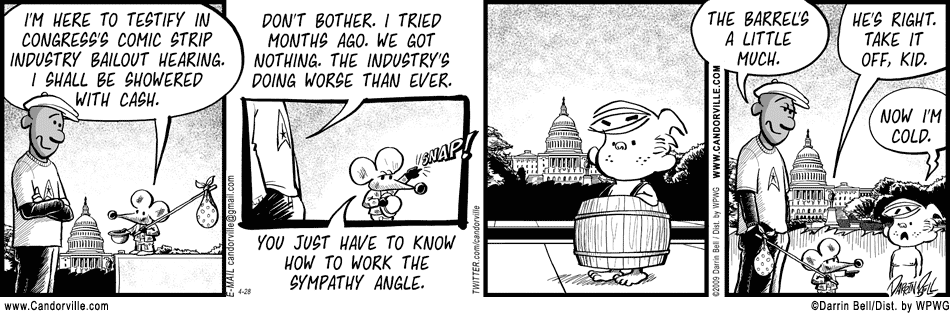
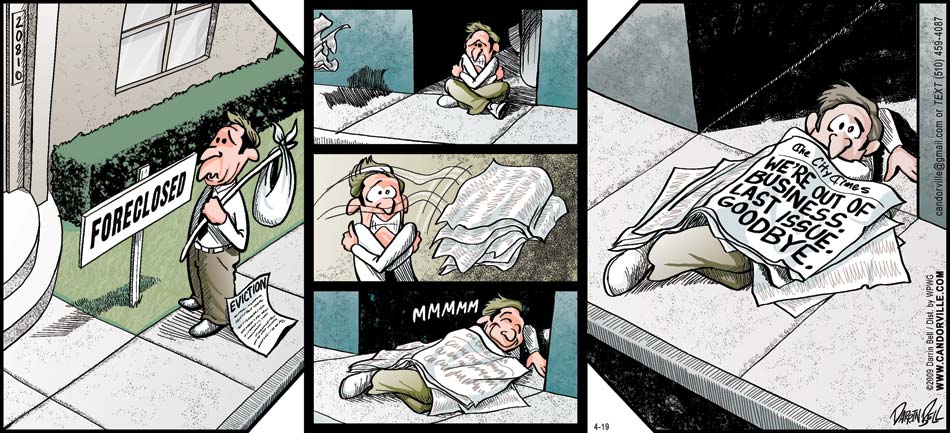
Right now I’m thinking about one of my client papers. The last time I visited this paper, just a few months ago, was the most depressing visit to a newspaper I’ve ever experienced. The editor asked me to come down to the newsroom to meet a high school kid who might want to be a cartoonist when he grew up. The editor was great. I loved meeting her. The ombudsman I met was great, and we all had a nice conversation. But the newsroom at this major metropolitan paper – this icon – was a ghost town. Row after row of empty cubicles, with maybe four or five people drifting through the empty room while I was there. I tried to imagine everyone was off covering some huge breaking story. Maybe the mayor had just been caught with an underage undocumented immigrant planting bombs in the reservoir, and the paper needed to cover it from dozens of different angles. It made the echoes and the silence of the cavernous and dimly-lit newsroom a little easier to take. While I was talking to the high school kid, I couldn’t help but think back to almost a decade earlier, when I’d been invited to that same newspaper to meet its editorial cartoonist. I was just a couple years older than this kid I was talking to. Back then I was worried about getting in everyone’s way because the newsroom was overflowing with intensely focused people rushing back and forth, people in ties and suspenders or in pearls and earrings holding animated conversations with each other or with their cell phones, phones ringing, doors opening and closing, and faxes coming through… In the few short months since I met the high school kid, my friend at the paper (who’d also been my editor back when I freelanced editorial cartoons) was let go. Something tells me the bar at the National Cartoonists Society convention is going to be packed this year. I’ll have to bring money, though, because I’m told this year they can’t afford an open bar.

Join the community

Join the community to converse with other Candorville, Rudy Park, THE TALK, and Darrin Bell Political Cartoons readers in a positive environment, to get access to thousands of archived editorial cartoons and comic strips, and to read behind-the-scenes reports and mini essays on important and not-so-important topics.